

Yes, there is still a Government grant for workplace EV chargers, but this is its final year. The OZEV Workplace Charging Scheme (WCS) covers up to 75% of the cost of buying and installing chargepoints, capped at £500 per socket for installations completed on or after 1 April 2026, and it closes on 31 March 2027 (GOV.UK, Workplace Charging Scheme). In this guide, the team at Green Sky Renewables explains who qualifies, what the grant is worth, and how businesses in Manchester and the North West can claim before the scheme ends.
What is the Workplace Charging Scheme?
The WCS is a voucher scheme run by the Office for Zero Emission Vehicles (OZEV) and administered through the DVLA. It supports organisations with the cost of installing electric vehicle chargepoints at their premises. The headline terms are straightforward (GOV.UK, Workplace Charging Scheme):
- Up to 75% of the total purchase and installation cost, including VAT
- Capped at £500 per socket for installations completed from 1 April 2026 (installations completed before that date receive up to £350 per socket)
- Up to 40 sockets across all your sites per applicant
The per-socket rate rose from £350 to £500 on 1 April 2026, when OZEV extended the scheme for a final year (GOV.UK, “Changes to electric vehicle chargepoint grant schemes from 1 April 2026”). For a business fitting ten sockets, that is up to £5,000 off the project cost.

Who is eligible?
The scheme is open to businesses, charities, public sector organisations and small accommodation businesses across England, Wales, Scotland and Northern Ireland. The main conditions to be aware of (GOV.UK, Workplace Charging Scheme):
- You need dedicated off-road parking clearly associated with your premises. If you do not own the property, you need the landlord’s consent.
- For businesses, the parking must be for staff or fleet vehicles, not customers, although staff chargepoints can be opened to local residents outside working hours. Charities, public authorities and small accommodation businesses face no restriction on who uses them.
- You must use an OZEV-authorised installer. Claims made through non-authorised installers are not paid.
- The installation cannot be something you were already required to do, for example under building regulations for new builds or a planning condition.
You will also need a Companies House number, VAT registration number or business rates bill as evidence. GOV.UK recommends having your site surveyed by an installer before you apply, which is the natural first step in any case.
What happened to the other business EV grants?
The WCS is now the main route for workplaces. Three related grants, the staff and fleets grant, the commercial landlord chargepoint grant and the residential landlord infrastructure grant, closed to applications on 31 March 2026 (GOV.UK, “Changes to electric vehicle chargepoint grant schemes from 1 April 2026”). If you were planning around one of those schemes, the WCS is the one still open, and it is worth acting while it is: funding is confirmed only until 31 March 2027, and the Government has said this is the final year of the current grant portfolio.

How to claim, step by step
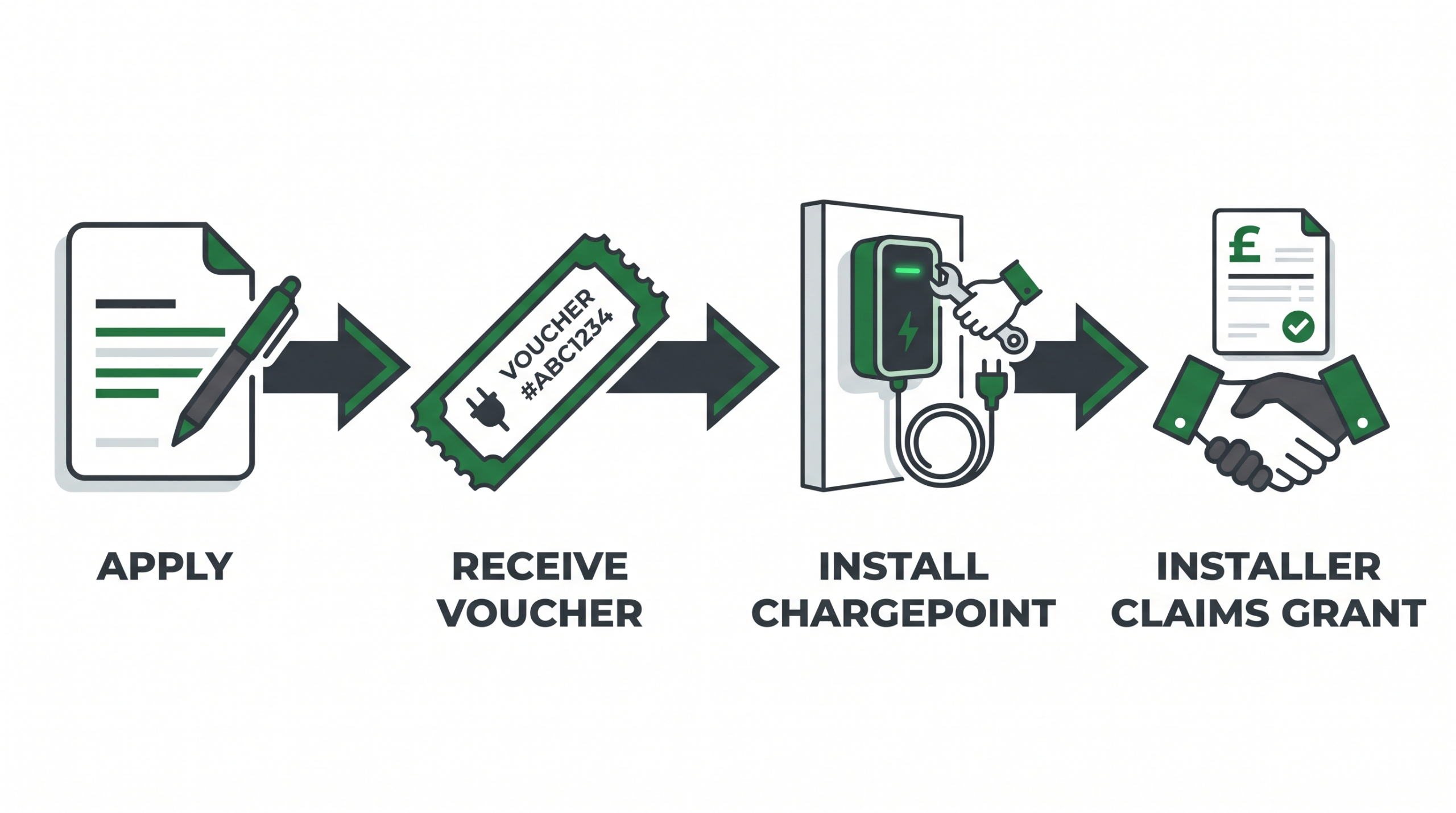
- Get a site survey. An installer assesses your parking, electrical supply and cable routes, and recommends the right chargepoints and layout. Green Sky Renewables carries out this assessment before quoting on any commercial EV charger installation.
- Apply online. You complete the WCS application form on GOV.UK. Successful applicants receive a voucher code by email, normally within five working days.
- Book the installation. The voucher is valid for 180 days, so the chargepoints must be installed and claimed within that window.
- The installer claims the grant. Once the work is complete, your authorised installer claims the grant on your behalf, so the saving comes off the project rather than you waiting for a rebate.
If you later want more chargepoints, you can apply for further vouchers up to the 40-socket ceiling.
Is workplace charging worth it beyond the grant?
For most organisations, yes. Workplace charging supports staff who cannot charge at home, makes fleet electrification practical, and signals credible sustainability commitments to customers and tenants. Chargepoints also pair well with solar: a rooftop array can offset daytime charging demand, which is exactly when workplace chargers are busiest. If you are weighing both, our commercial renewable energy team can model solar, battery storage and EV charging as one system rather than three separate purchases.
Frequently asked questions
How much is the workplace EV charging grant in 2026?
Up to £500 per socket for installations completed on or after 1 April 2026, covering up to 75% of purchase and installation costs, for a maximum of 40 sockets across all sites (GOV.UK, Workplace Charging Scheme).
When does the Workplace Charging Scheme end?
The scheme has been extended for a final year and closes on 31 March 2027 (GOV.UK). If workplace charging is on your plan, this is the year to act.
Can any electrician install grant-funded chargers?
No. The grant is only paid when the work is carried out by an OZEV-authorised installer, so check authorisation before you commit.
Can our customers use grant-funded chargepoints?
For businesses, the WCS requires the parking to be for staff or fleet use, though you can open chargers to local residents outside working hours. Charities, public bodies and small accommodation businesses can let anyone use theirs.
Do we have to pay upfront and claim the money back?
No. Once your voucher is issued and the installation is complete, the installer claims the grant, so the discount is applied to the project cost.
Thinking about workplace charging before the scheme closes? Talk to our Manchester-based commercial team about a site survey.